
12th bwHPC Symposium in Konstanz: Flashback
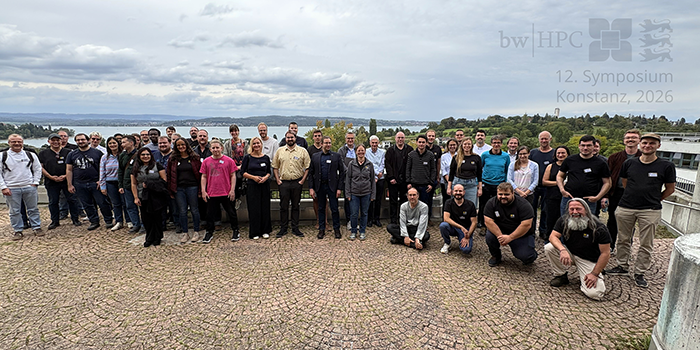
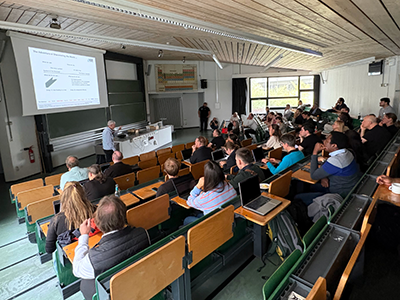
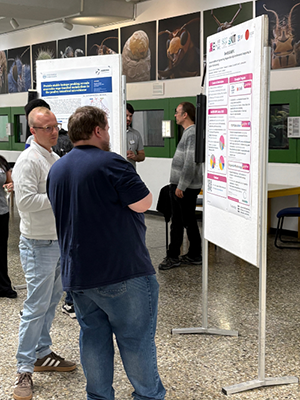
The 12th bwHPC Symposium brought together around 80 researchers, HPC users, infrastructure experts and cooperation partners in Konstanz. Following the welcome address by Andreas Schnell, the symposium offered insights into the wide range of scientific questions being addressed with the aid of Baden-Württemberg’s high-performance computing infrastructure.
The presentations demonstrated how bwHPC resources enable researchers to process enormous datasets, conduct complex simulations and develop reproducible computational workflows. The programme covered astrophysics, life sciences, medicine, materials research, electrical engineering, quantum physics and energy-market modelling.
Keynote explores neutron stars and gravitational waves
A central highlight was the keynote by Professor Konstantinos Kokkotas, entitled “Neutron Star Dynamics and Gravitational Waves.” Neutron stars are among the densest objects in the universe and provide exceptional conditions for investigating gravity, matter and fundamental physics.
Prof. Kokkotas, from University of Tübingen, presented recent results obtained through large-scale, three-dimensional numerical simulations. His talk addressed the nonlinear evolution of neutron stars, the dynamics of interacting neutron stars before and during a merger, and the resulting gravitational and electromagnetic signals. He also discussed simulations based on alternative theories of gravity and the question of whether observations could reveal deviations from Einstein’s general theory of relativity.
The keynote underlined the importance of accurate modelling for a new generation of gravitational-wave observatories. Future facilities such as the Einstein Telescope, Cosmic Explorer, LISA and Taiji are expected to provide increasingly detailed signals from compact objects. Interpreting these observations will require sophisticated models of neutron stars, black holes and surrounding matter. Solving the coupled Einstein and hydrodynamics equations at the required accuracy is only possible with modern HPC systems and advanced parallel algorithms.
Talk Awards honour research on mitochondrial microproteins and medical imaging
Two presentations received a Talk Award, recognising both the scientific relevance of the work and the quality of its communication.
Sarah Viola Emser was honoured for her presentation “Mining Multi-Omics Data for Hidden Mitochondrial Transcripts and Microproteins in Stress-Related Disorders.” Her work investigates a largely unexplored layer of genetic information in mitochondria. While standard annotations contain 37 canonical mitochondrial genes, recent findings suggest that additional transcripts and very small proteins may influence cellular stress responses, metabolism and resilience.
Dr. Emser presented a scalable computational framework that extends conventional genome and protein references with curated non-canonical mitochondrial sequences. This allows existing transcriptomic and proteomic datasets to be reanalysed with established nf-core workflows. Applied to stress-related psychiatric conditions such as post-traumatic stress disorder and major depressive disorder, the approach has already identified additional mitochondrial transcripts and candidate microproteins that would remain invisible in standard analyses. Future integration of ribosome-profiling and proteomic data will help determine whether these candidates are actively translated into proteins.
The second Talk Award went to Johannes Schulze for his presentation on the “CMF Fracture Segmentator,” an nnU-Net-based system for the automated segmentation of mandibular fractures. Virtual surgical planning requires fractures and individual bone fragments to be identified in three-dimensional CT or cone-beam CT images—a process that is traditionally time-consuming when performed manually.
Using computing resources on the bwUniCluster, the neural network was trained on 123 datasets. It achieved a Dice score of up to 0.98, indicating very high agreement with manually generated segmentations. The automated method produced results of comparable quality within only a few minutes. The work therefore has the potential to accelerate virtual surgical planning considerably, while its use of open-source software could facilitate broader clinical adoption. Further training with larger, multicentre and more diverse datasets is expected to improve its applicability.
From brain activity and chip design to microbiomes and quantum systems
The broader programme illustrated the diversity of research supported by bwHPC. Sophie Aimon presented a GPU- and HPC-accelerated pipeline for converting light-field microscopy data from larval zebrafish into three-dimensional maps of brain activity. The workflow processes hundreds of gigabytes per experiment on the bwForCluster NEMO2 and identifies thousands of functional activity patterns.
Johannes Stark demonstrated how industry-standard chip-design software can use NEMO2 for computationally demanding signoff simulations. The workflow achieved speed-ups of up to 2.1 on CPUs and 2.5 on H200 GPUs, enabling more comprehensive validation before costly chip production.
Further contributions covered the reconstruction of almost 20,000 viral populations from chicken-gut metagenomes, standardised microbiome profiling across six laboratories, evolutionary algorithms, electrochemical materials, bacterial recognition of human cell surfaces, dissipative quantum matter and electricity-market modelling. Across these fields, the talks showed that HPC is not simply about faster computation: it makes new scientific questions accessible, supports reproducible analysis and allows researchers to work with data volumes and model complexities that would otherwise be unmanageable.
Strong cooperation with bwFDM and bwRSE4HPC
The participation of bwFDM and bwRSE4HPC, cooperation partners of bwHPC, was especially valuable. Their involvement highlighted that successful computational research depends not only on hardware, but also on professional research data management, sustainable software development and close interaction between researchers, infrastructure providers and Research Software Engineers.
bwFDM contributes expertise in handling research data throughout its lifecycle, while bwRSE4HPC strengthens sustainable software engineering in the HPC environment. Together, these initiatives complement bwHPC’s computing infrastructure and help ensure that scientific workflows are efficient, reusable and reproducible.
Looking ahead to 2027
We thank all speakers, cooperation partners and participants for their contributions, discussions and active engagement. With around 80 attendees, the 12th bwHPC Symposium once again demonstrated the strength and diversity of Baden-Württemberg’s HPC community.
We hope all attendees enjoyed their time in Konstanz and look forward to welcoming them back for the next bwHPC Symposium in 2027.