The Secondary Neutrons Project in Heidelberg
| Project Manager | Dr. José Vedelago |
|---|---|
| Principal Investigator | Dr. José Vedelago |
| Author of this Article | Jonas Mahnke, Dr. Christina Stengl |
| Affiliation | Division of Medical Physics in Radiation Oncology, German Cancer Research Center (DKFZ) |
| Project duration | 03/2020 - ongoing |
| Platform used | bwUniCluster 2.0 |
| bwHPC Domain | Medical Science |
| DOI of Publication | 10.1088/1361-6560/ae1ee6 |
| Project added | 20.01.2026 |
Radiotherapy using protons or ions offers a distinct advantage compared with photons, as they allow precise dose delivery to the tumor, minimizing healthy tissue exposure. Secondary neutrons generated during ion beam radiotherapy are an unavoidable by-product of nuclear interactions and can contribute unwanted dose to both patients and medical staff. Our research group “Translational Research for Ion Beam Therapy” (https://www.dkfz.de/en/translational-research-for-ion-beam-therapy) investigates the out-of-field doses generated during ion beam therapy, with the ultimate goal of improving the radiotherapy treatments delivered to cancer patients. For these, our research activities span from the development of experimental detection techniques to high-performance computational Monte Carlo (MC) simulations.
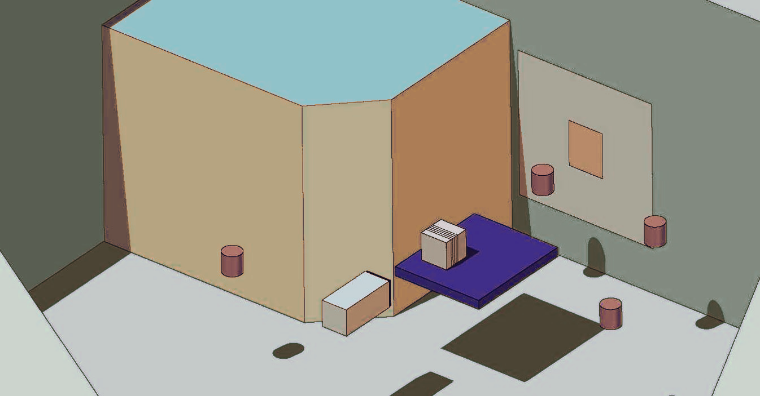
In this paper, we investigated secondary neutrons from room scattering during ion radiotherapy. Many of these neutrons originate from scattering off the walls, ceiling, floor, and surrounding equipment. Despite their importance for radiation protection, the effect of treatment room structures on neutron scattering has not been fully quantified for different ion species. We analyze how protons, helium, carbon, and oxygen ions at clinically relevant energies contribute to this secondary neutron dose. Experimental measurements were complemented by detailed MC simulations that replicated the irradiation room geometry, including shielding structures and major equipment.
To obtain statistically reliable results for the MC simulations within a reasonably low uncertainty, multiple simulations had to be run in parallel. This was possible thanks to the computational resources of the BwUniCluster 3.0. Our research revealed good agreement between measurements and MC simulations across the four primary ions, demonstrating that the simulated geometry reliably reproduced the secondary neutron field. On average, the room return effect accounted 48 % to 59 % of the total ambient dose equivalent, underlying the relevance of such high-performance simulations including detailed geometry.
The room return effect can vary depending on the geometry of the treatment room. Accurate modeling of the treatment room increases the reliability of MC simulations and helps reduce uncertainties in secondary neutron dose, which is particularly important for vulnerable patients such as children or pregnant women. With the use of the cluster, we plan to perform studies using CTs of phantoms imitating the anatomy of patients, potentially allowing more patients to benefit from this treatment modality.