Deep Learning for Neutron Dosimetry with Fluorescent Nuclear Track Detectors
| Project Manager | Dr. José Vedelago |
|---|---|
| Principal Investigator | Dr. José Vedelago |
| Author of this Article | Long-Yang Jan Thai, Dr. José Vedelago |
| Affiliation | Heidelberg University and Division of Medical Physics in Radiation Oncology, German Cancer Research Center (DKFZ) |
| Project duration | 10/2024 - ongoing |
| Platform used | bwUniCluster 3.0 |
| bwHPC Domain | Medical Science |
| DOI of Publication | 10.1016/j.radmeas.2026.107662 |
| Project added | 21.05.2026 |
One of the main goals of our research group “Translational Research for Ion Beam Therapy” is to improve the quantification of out-of-field doses during proton and light ion beam radiotherapy. Among our research activities, we are assessing how artificial intelligence can help us improve neutron dosimetry with advanced radiation detectors.
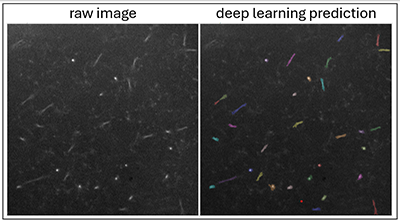
In this paper, we combined the features of Fluorescent Nuclear Track Detectors (FNTDs) with deep learning architectures to automatically identify micrometric traces of charged-particle fragments generated by neutron interactions. The trained deep learning model acts like a highly sensitive digital “radiation camera”, allowing us to analyse large datasets of microscopic FNTD images. Without the high-performance computing capacity of the bwUniCluster 3.0, the training of the deep learning model would take several weeks on a personal computer. With these resources, we were able to show that our method can estimate radiation doses with high accuracy under complex real-world conditions.
The project has important potential benefits for society, including better monitoring for radiation-exposed people, with a more reliable monitoring of radiation exposure and optimization of cancer treatment by reducing unnecessary exposure during radiotherapy. With the use of the bwHPC cluster, we plan to continue this project, scaling it to higher neutron energies, of extreme relevance for the secondary neutrons produced during proton and light ion beam radiotherapy.