Turbulence generation and data assimilation in wall-bounded flows with a latent diffusion model
| Project Manager | Prof. Dr. Heng Xiao |
|---|---|
| Principal Investigator | Prof. Dr. Heng Xiao |
| Author of this Article | Fabian Steinbrenner, Baris Turan |
| Affiliation | University of Stuttgart |
| Project duration | 07/2025 - 07/2026 |
| Platform used | Helix |
| bwHPC Domain | Mathematics and Computer Science |
| DOI of Publication | 10.48550/arXiv.2603.02143 |
| Project added | 30.07.2026 |
Predicting unsteady turbulent flows and quantifying their uncertainty in real time is a fundamental challenge in fluid mechanics. It is most severe for high-Reynolds-number, wall-bounded flows such as those in wind farms, where turbulence is multiscale, non-stationary, and only sparsely observed. Classical data assimilation combines incomplete observations with model predictions, but relies on repeated solutions of the governing equations and therefore inherits their high computational cost. Generative models offer a scalable alternative: instead of integrating the equations, they learn the underlying probability distribution of flow states and draw new, statistically consistent samples from it.
We couple a β-variational autoencoder (β-VAE) with a transformer-based diffusion model (DiT) in a two-stage framework. The β-VAE compresses three-dimensional DNS snapshots into a compact latent space, while the DiT learns their temporal evolution. The training data stem from a spectral direct numerical simulation (DNS) of plane Couette flow. Bayesian posterior sampling then enables data assimilation from physical-space observations without retraining. For the training of all deep-learning models, the resources on bwForCluster Helix were essential, as those datasets with thousands of snapshots demand significant GPU power and storage space.
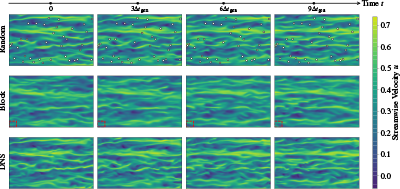
Using only 16 latent degrees of freedom, a compression ratio of O(10⁵), the model generates spatio-temporal flow fields that reproduce DNS turbulence statistics up to fourth-order moments, as well as two-point correlations and energy spectra. We further demonstrate two data assimilation scenarios, scattered and block observation, and identify distinct failure modes: overly sparse observations can be over-weighted and amplify noise, while overly dense or correlated conditioning distorts the learned prior. These effects parallel known limitations of classical ensemble-based data assimilation.
Future steps for the usage in wind farms include generalisation beyond the training distribution, longer temporal horizons via autoregressive rollouts, and the handling of complex geometries such as wind turbines through additional conditioning variables.
Figure descriptions:
Figure 1: Schematic of the proposed data assimilation framework. A latent diffusion model is trained to learn the prior distribution of four-dimensional turbulent plane Couette flow. The model performs Bayesian-like data assimilation with two observation types: scattered observations and a localized rectangular data block. Statistically consistent flow-field samples are generated from the posterior distribution.
Figure 2: Assimilation of instantaneous observations to turbulence generation. Contours of streamwise velocity are shown. Sensor locations are indicated by circles (random) and a dashed box (block). In the scattered observations task, every fifth sensor location is displayed for clarity.